Quick experiment: start a new online order through five different multi-location QSR restaurant chains that use Olo, one of the most widely trusted names in restaurant ordering technology. Now compare them side by side.
Odds are, they look nearly identical. Same layout, same flow, same feel, just with a different logo pasted on top. Olo’s core ordering engine is genuinely reliable; that’s exactly why so many growing restaurant brands rely on it. But out of the box, it doesn’t reflect what makes your brand actually your brand.
That gap between a “reliable ordering platform” and an ordering experience that actually feels like your brand is exactly the problem we solve for multi-unit restaurant brands. When online ordering feels like a natural extension of the in-restaurant experience, it can reduce friction, improve the customer experience, increase conversion, and ultimately help drive more sales. Here’s what that gap actually costs you, and how a real case study, Charleys Cheesesteaks, shows what’s possible when you close it.
The problem with off-the-shelf online ordering
If your brand is running the standard, turnkey implementation, you’re probably running into a few frustrations that don’t show up on the sales sheet:
● Everyone looks the same. Because Olo’s core product is template-driven, guests ordering from 50 different restaurants on stock Olo see a nearly identical experience. There’s very little room to stand out from the competitor down the street.
● Your menu outgrows the template. As menus get more complex, with modifiers,
combos, bundles, and rotating promotions, the out-of-the-box setup often can’t keep up with how you actually want it presented.
● Guests leave your website mid-order. A standard setup hands guests off from yoursite.com to a completely different domain, something like yoursite.olo.com, breaking the brand experience at the moment they’re deciding to buy.
● You lose your own data. That domain jump cuts off your own analytics right when a guest is converting, the single most important moment to understand.
● When guests leave your website to complete an order, you can lose more than brand continuity. You can also lose visibility into what happens at the most important point in the customer journey: when a guest moves from browsing to buying. That can make it harder to connect website behavior to completed orders, understand where customers drop off, and measure the true impact of your digital experience.
A custom Olo integration changes that. By building the ordering experience directly into your site while still using Olo’s ordering engine behind the scenes, guests can move from menu discovery to checkout without feeling like they’ve left your brand. Just as importantly, your analytics and conversion data can stay connected to the rest of the customer journey, giving your team a clearer picture of what is actually driving orders.
None of that is a knock on Olo itself. It’s a limitation of treating a powerful ordering engine like a plug-and-play widget instead of a foundation to build on.
Our approach: keep the engine, take back the experience
We don’t replace Olo, and we don’t think you should either. Instead, we design, build, and optimize a custom layer that sits directly on top of Olo’s Ordering API. The reliable engine stays exactly where it is. What changes is who’s actually in control of your guest’s ordering experience.
That’s the same approach we’ve used for multi-unit brands including Bibibop, Lennys, and East Coast Wings, and it’s exactly how we approached the challenge at Charleys Cheesesteaks.
Case study: turning “craveability” into real ecommerce growth
Charleys Cheesesteaks operates 600+ locations across 46 states and 17 countries, and had just gone through a brand refresh built entirely around the idea of “craveability.” The problem: their website hadn’t caught up to that new brand promise yet.
What the site needed: a full redesign, deep integration with online ordering, and a location-aware experience that made finding and ordering from the nearest Charleys effortless, no matter where a guest is at that moment.
Our approach:
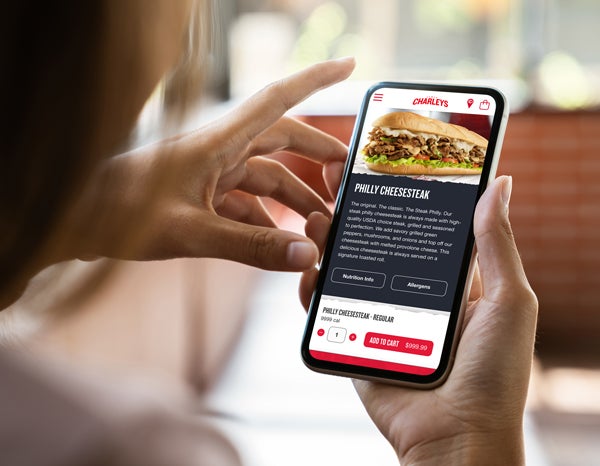
● Complete UI/UX redesign featuring a fully custom front-end built on OLO’s APIs, giving us 100% control over the brand’s ordering experience
● Full technical SEO audits and fixes, to target ranking factors like page speed and schema
● Onsite SEO recommendations, plus Google Business Profile optimization to strengthen local SEO and link authority
The solution carried the brand’s new tagline straight into the product: Crave. Click. Enjoy. Repeat. The new site automatically detects each visitor’s location and sets their nearest Charleys as the default store, pulling menu, promotions, hours, and store data live from the ordering system. Guests can browse a map to explore other nearby locations, and every screen is built to move someone from craving to checkout with as little friction as possible.
The results, two years post-launch
● 609 keywords ranking on page 1 of search, up from just 24 in October 2021
● +166% increase in organic search impressions
● +53.5% increase in organic search clicks
● +61.5% increase in revenue from search traffic, compared to 2021
That’s not a coincidence. That’s what happens when a custom ordering experience and a real SEO strategy work together instead of existing as two disconnected projects.
Why a custom integration actually moves the needle
A few specific advantages a custom build unlocks that an off-the-shelf implementation simply can’t:
You stay on your own domain. A custom-built front end keeps guests on yoursite.com from browse to checkout, no jump to a subdomain. Your brand experience, and your own analytics data, stay fully intact.
You get real SEO control. Custom integration gives us control over page structure, schema, and content around the ordering experience itself, the same foundation that helped Charleys grow to 609 page-1 keywords. That’s territory a stock ordering widget simply can’t compete in.
Your location data stays current, automatically. We sync store data directly from Olo, so menus, hours, and pricing stay accurate everywhere, often paired with a custom location finder built for fast, intuitive store discovery.
Rewards and mobile stay unified, not bolted on. We’ve integrated loyalty and rewards programs through both Punchh and Paytronix, connecting them to Olo via Single Sign-On so guests move between rewards, account, and ordering without logging in twice. On the mobile side, we build the ordering experience and platform itself, with the native app framing our mobile web build, so the ordering flow, promotions, and rewards stay consistent whether a guest orders from the app or the mobile site.
Is your ordering experience actually working for your brand?
A few questions worth asking if your multi-location brand is currently running a stock setup:
● Does your online ordering experience actually look and feel like your brand, or could it be swapped with a competitor’s logo and nobody would notice?
● Are guests leaving your domain to complete an order, and are you losing visibility into that conversion moment as a result?
● Is your SEO strategically connected to your ordering experience, or are they being managed as two separate, disconnected efforts,which can not drive sales?
If any of those hit close to home, there’s a strong chance your current setup has a ceiling, and that ceiling is costing you both brand experience and real revenue.
Let’s build your Olo experience
This is exactly the kind of work our interactive and SEO teams specialize in: taking a reliable platform like Olo and building the custom layer on top of it that actually reflects your brand, converts more guests, and gives you back the data and control that a stock implementation quietly takes away.
Let’s talk. No cost, no catch. We start every relationship with a conversation about what’s working and what isn’t for your ordering experience today.