If you’ve spent any time in ecommerce circles lately, you’ve heard the word “headless” thrown around like it’s the only serious answer to a modern online store. Headless commerce, composable architecture, decoupled front-ends. It all sounds impressive. It also sounds like a lot of vendors, a lot of integrations, and a lot of engineering hours before you ever sell a single product.
For most direct-to-consumer brands, and especially fast-growing ones in categories like clean beauty, that complexity isn’t a feature. It’s a tax. And it’s a tax that shows up in the metric that matters most: customer acquisition cost (CAC).
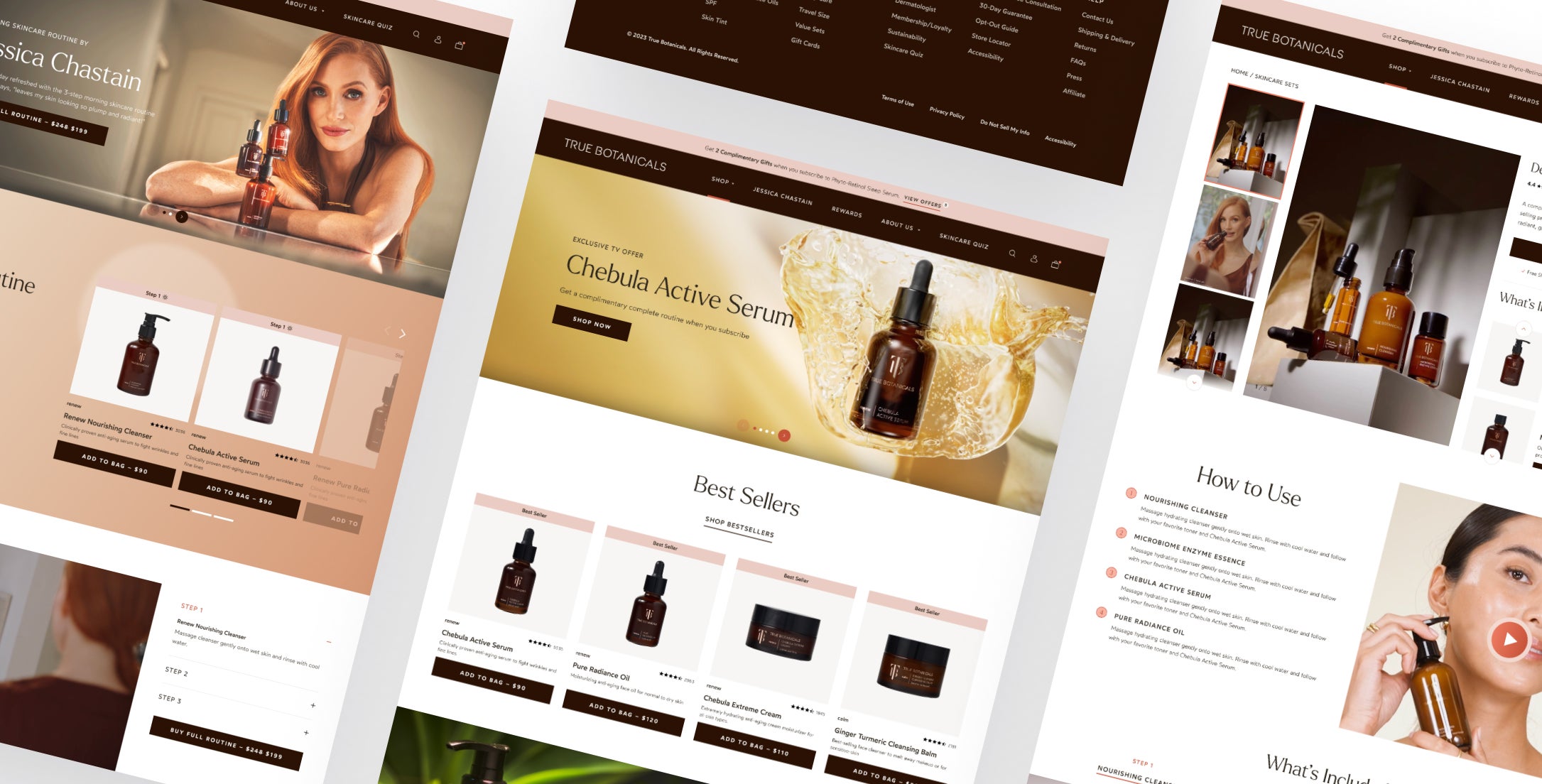
We saw this play out firsthand with True Botanicals, a luxury clean skincare brand competing in one of the most crowded, most skeptical corners of ecommerce. Here’s what we learned about why a clean, centralized Shopify build beats a fragmented tech stack, and what it means for any premium DTC brand thinking about its next platform move.
The problem: a saturated market with very skeptical shoppers
Clean beauty shoppers are a different breed of customer. They’re informed. They’re skeptical of marketing claims. They’ve been burned by “natural” labels that turned out to be marketing spin. And they have no shortage of other clean beauty brands competing for their attention and their wallet.
That combination creates two very specific business problems:
High CAC. In a saturated market, every paid channel gets more expensive as more brands bid for the same skeptical audience. If your website can’t convert that expensive traffic once it arrives, you’re burning ad spend on visitors who bounce.
A steep trust gap. Clean beauty customers won’t take your word for it. They want to see the formulation, understand the efficacy, and feel confident before they hand over their email, let alone their credit card.
And there’s a third challenge layered on top: turning that first purchase into a subscription customer. One-time buyers are expensive to acquire and don’t move the lifetime value (LTV) needle nearly as much as a shopper who sticks around for repeat orders. If the path from “first visit” to “subscriber” has friction anywhere along the way, that revenue never materializes.
Solving all three of those problems starts with the website. Which is exactly where the platform decision comes in.
Why “headless” isn’t automatically “better”
Headless architecture separates your front-end (what customers see) from your back-end (where your product, inventory, and content live), connecting the two through custom APIs. In theory, that flexibility lets you build a completely custom experience.
In practice, for most mid-sized DTC and luxury brands, it means:
- More vendors to manage. Your CMS, your ecommerce engine, your front-end framework, and your subscription tool are now four different systems that all need to talk to each other correctly, all the time.
- Slower iteration. Want to test a new product page layout or update a promotion? What used to be a quick edit now might require developer time across multiple systems.
- More points of failure. Every additional integration is one more place where things can break, checkout can hiccup, or a page can load slowly, and slow, buggy experiences are exactly what drives already-skeptical shoppers away.
None of that is hypothetical. It’s engineering overhead and ongoing cost that most brands don’t actually need, especially when the real goal isn’t architectural flexibility for its own sake. It’s converting more of the traffic you’re already paying for.
What we did instead: centralize, simplify, and let the UX do the selling
For True Botanicals, the better path wasn’t a more complex stack. It was a more focused one: a clean, high-performance experience built directly on Shopify, designed around UI/UX best practices rather than platform novelty.
That meant:
Making product efficacy impossible to miss. Skeptical shoppers convert when they can see proof, not just promises. We restructured product pages to lead with clinical results, ingredient transparency, and the “why” behind the formulation, not buried three scrolls down, but front and center where a shopper is actually deciding whether to trust the brand.
Streamlining the path to purchase. Every extra click, every confusing menu, every moment of “wait, where do I find that” is a moment a skeptical, price-conscious shopper can decide to leave. We simplified navigation and the buying path so the site did the convincing, not the customer’s patience.
Building for the subscription decision, not just the sale. Converting a first-time buyer into a subscriber isn’t a checkbox at checkout, it’s a trust decision. We designed the experience so the value of subscribing (savings, consistency, the relationship with the brand) was clear well before the customer ever reached the cart.
Keeping the whole system centralized and fast. With everything running through one well-built platform instead of a patchwork of connected tools, pages load faster, updates ship faster, and there are simply fewer places for something to quietly break and quietly cost you conversions.
The result wasn’t a flashier tech stack. It was a faster, more trustworthy, more convertible one, which, for a luxury brand competing on both credibility and cost-efficiency, is the entire point.
The takeaway for growing DTC and luxury brands
Headless and composable commerce absolutely make sense for certain enterprise-scale businesses with the engineering teams to support them. But for most fast-growing beauty, wellness, and premium DTC brands, chasing that complexity before you need it is solving a problem you don’t have yet, while ignoring the one you do: getting more of your paid traffic to actually convert.
A few questions worth asking before you go chasing a more “advanced” stack:
- Is your current platform actually slowing down conversions, or is it your page design, content, and UX?
- How much developer time does every small site change currently require, and is that sustainable as you scale?
- Would your team rather spend the next quarter managing integrations, or testing product pages and messaging that could actually move CAC and LTV?
For a lot of brands, the honest answer points toward centralization, not fragmentation.
How Wildfire approaches ecommerce platform decisions
This is the kind of work we love: taking a brand with real growth ambitions and building the digital foundation that actually supports it, not the trendiest one. Whether that’s strategy around your customer journey, interactive design and development for your Shopify build, SEO and GEO work that makes sure your product pages are found on Google and surfaced in AI search results, or media planning that makes sure the traffic you’re paying for lands on a site built to convert it, we look at the whole picture before recommending a platform path.
If your ecommerce site feels like it’s fighting you instead of converting for you, or if you’re weighing a headless build against something simpler, let’s talk it through.
Curious what a centralized, conversion-focused platform could do for your brand’s CAC and LTV? Let’s talk.